AI WITHOUT NONSENSE
AI: hype or edge? Numbers, not opinions.
Seven percent of Dutch SMEs have AI in a core process. Fifty percent haven't started. This page shows what makes the difference. Numbers with sources, four frictions you'll recognize, a foundation that works. Two minutes to read.
Three concrete next steps at the end. For founders and leadership of Dutch organizations between EUR 10M and EUR 300M revenue.
THE FACTS
The market waits. The technology runs. That's where your edge sits.
You've seen enough presentations. Enough pilots that lead nowhere. Enough consultants with three-year roadmaps. This page is different: facts with sources, in two minutes.
AI is everywhere in the news. In practice, it's still rarely deployed. That's not a problem. That's your edge, if you move now.
7%
of Dutch SMEs have AI embedded in a core process
Source: CBS, AI-monitor 2025
43%
experimenting with AI. 50% haven't started.
Source: KVK Entrepreneur Panel AI, 2025
3%
globally run agentic AI extensively or fully in production
Source: Deloitte State of AI in the Enterprise, Jan 2026, n=3,199
The productivity gap
| Indicator | Growth per year | Source |
|---|---|---|
| AI capability | ~100% | Various benchmarks 2024-2025 |
| Dutch labor productivity | 1.1% | CBS, 2024 |
That difference compounds. Whoever invests in AI in a core process now builds a lead that can't be caught up later.
"Technology is sprinting. The market is still waiting. That gap is the opportunity."
WHERE IT STALLS
Why AI projects stall before they start
Eighty percent of AI initiatives don't reach production. That's not a BrainStax statistic. That's the Dutch market. Ask five fellow founders what their AI pilot delivered last year. Count how often you hear "we learned from it." It doesn't stall on the technology. It stalls on what sits underneath: the three pillars of people, data, and technology. Working together, or past each other?
"AI projects don't stall because AI doesn't work. They stall because organizations start with the technology, not with the friction that costs the most. That's the difference."
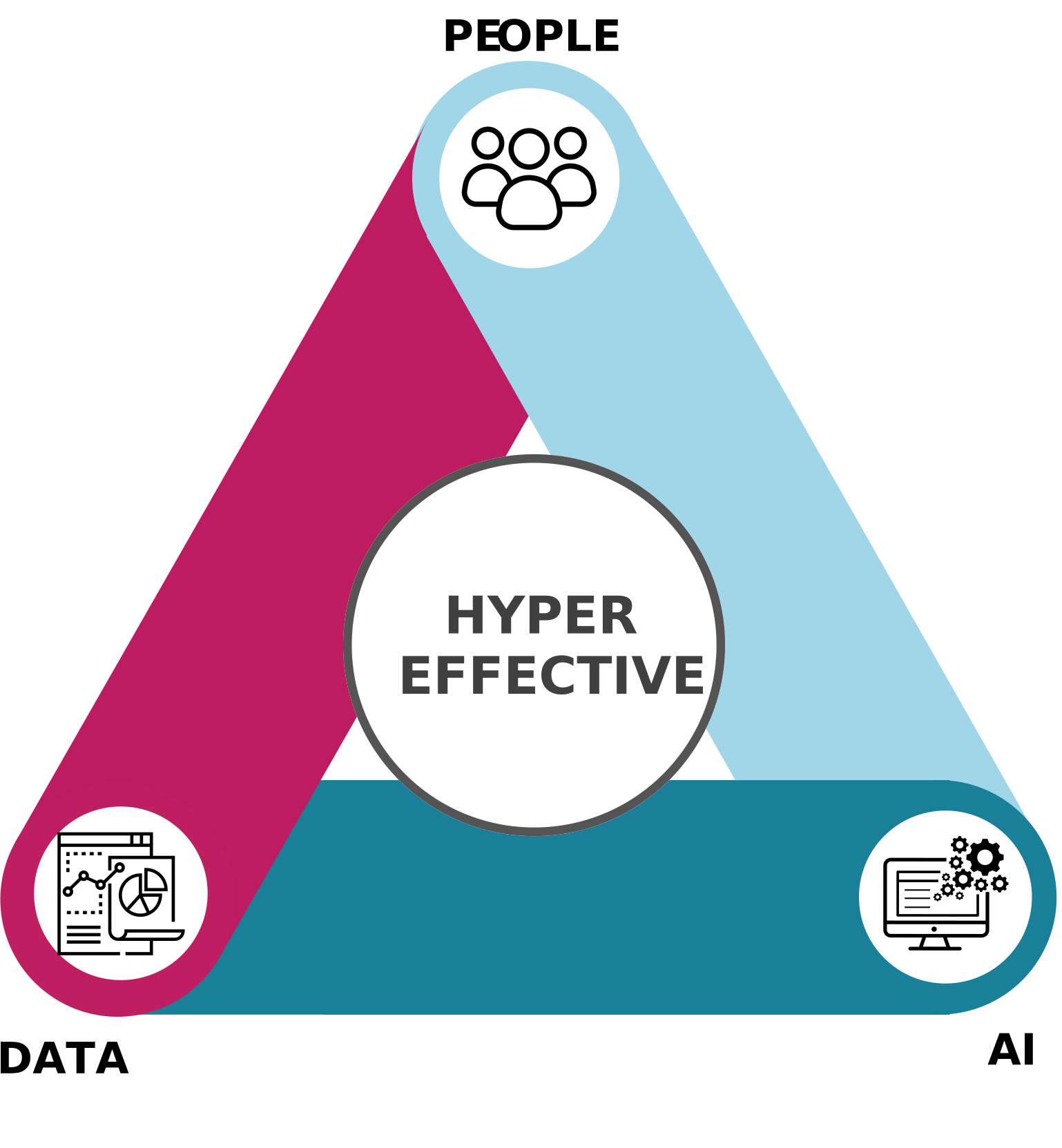
The triangle underneath: People, Data, Technology
An organization only becomes effective when people, data, and technology reinforce each other. Not as three separate projects running in parallel.
People first, technology follows. The other way around doesn't work.
From insight to action. That's where the gap sits.
Every organization climbs the same data ladder. From Excel (people calculate manually), to BI dashboards (data becomes visible), to algorithms (data predicts), to AI assistants (data acts). Most organizations reach dashboards. The step to algorithms and assistants that do work independently? That's where most drop off. Not because it can't be done. Because the data isn't ready for it.
Four frictions you hear in every boardroom
DATA & IT
How do you know which data you can trust?
Employees call, email, and manually search for information that's already in your systems. Nobody feels responsible for data verification.
SUPPLY CHAIN
Why do shortages only become visible when the customer calls?
Inventory decisions on gut feeling, outdated reports, or manual Excel calculations.
PLANNING
Why does planning depend on one person?
Spreadsheets, disparate systems, or knowledge in one head. Changes are translated manually.
SALES
Quotes take too long and contain errors
Manually compiled from historical data, price lists, and product specs across different systems.
You hear this back in every organization above 100 FTE, regardless of industry, regardless of ERP system, regardless of how much you've already invested in IT. These are four of the seven frictions we eliminate.
And then there are the concerns that keep founders awake
73%
Data privacy and security
50%
Legal, IP, and compliance
46%
Governance and oversight
Source: Deloitte State of AI in the Enterprise, January 2026, n=3,199. The EU AI Act takes effect August 2026 for high-risk applications. Do you know which of your systems hit that threshold?
AI ACT READINESS
How prepared is your organization?
6 questions. 3 minutes. Personal compliance analysis based on People, Data, and Technology. For the August 2026 deadline.
WHAT WORKS
One foundation. All data sources. No system replacement.
We call it The Three-Pillar Foundation. A data layer under your existing systems, built on the triangle of people, data, and technology. Three pillars, one layer, no replatform. This is what the seven percent run in production. The other ninety-three percent don't.
Technically, the foundation is called BrainGrounds. It's not a replacement for what you have. It's a layer underneath that brings all data sources together. Your ERP stays your ERP. Your WMS stays your WMS. Your CRM stays your CRM. BrainGrounds connects to what's there and turns it into one central, reliable source.
And it runs on a private AI language model: your company data isn't used to train public AI models, and stays in a closed environment that only your people see.
Enterprise tech. SME+ budget.
Databricks isn't a matter of taste. It's the standard Shell, ABN AMRO, and Heineken run their data on, because one platform handles every data format: tables, documents, sensor data, images. We make that layer accessible for organizations between EUR 10M and EUR 300M revenue, on SME+ budget, at fixed price. Data stays at the source. No copies, no shadow administration. Every query logged, every data source traceable. Ready for EU AI Act compliance.
Three myths that hold founders back
"This becomes a replatform project."
It doesn't. BrainGrounds is a layer underneath. Your ERP, WMS, and CRM stay what they are. Your IT department stays in charge of the existing systems.
"Our data isn't clean enough for AI."
Nobody starts with clean data. We build the foundation on the data as it stands now, and make visible which sources are ready for the next step.
"The model shares our data with the world."
It runs on a private AI language model. Your company data isn't used to train public AI models. Every query logged, every source traceable.
Three solutions that run on the foundation
BRAINCHAT
Ask your own systems in plain language
Answers from ERP, CRM, and documents in one place. No phone calls, no manual searching.
"What's the steel plate inventory in Eindhoven?"
BRAINDOC
Procedures findable in seconds
Work instructions, quality documents, and protocols on your own documentation. Directly available on the shop floor.
"What's the protocol for material deviations?"
BRAINPLAN
Planning no longer dependent on one person
Operational data translated to planning decisions in real time. Changes automatically propagated.
"Optimize tomorrow's loading."
Fixed price, live in production
1
Data assessment
Map data sources, identify opportunities, input for strategy.
2
First solution live
BrainGrounds is running, BrainChat answers operational questions.
3
Expand
Eliminate the next friction, more sources, more users.
4
Continuously grow
Scales with new systems and ERP replacement.
Fixed price per sprint. Live in production. No throwaway investment: the foundation adapts when data sources change. Every step funds the next.
YOUR NEXT STEP
Four facts, one choice.
- AI capability doubles each year. Dutch labor productivity grows 1.1 percent. That gap won't close by itself.
- Eighty percent stall on data, not on technology.
- A foundation on your existing systems works. Replacement doesn't. No throwaway investment.
- Fixed price. Live in production. Every step funds the next.
"Every month without a foundation is a month your competitor widens that gap."

Anton de Nijs
Founder BrainStax · 10+ years data & AI · Databricks partner
Questions after reading? A short email works fastest. I reply personally within 24 hours.
anton@brainstax.com10 questions. 5 minutes. Get by email which of the seven frictions yields the most for your organization. No phone call, no sales pitch.
P.S. What you start today runs in production a few months from now. What you don't start, still won't be running a few months from now. That's the entire calculation.
LEARN MORE
Read more
The method
People, data, technology. How we go from friction to production.
Read about the M-D-T method →BrainGrounds
The foundation explained technically. For IT leads and data architects.
Explore the BrainGrounds platform →READ ALSO
Recent articles
INSIGHTS