How it works
One friction. Fixed price. Live in production.
Shortages only become visible when the customer calls. Reports take hours and nobody trusts the conclusions. Planning depends on one person.
Sound familiar?
You know the friction. You don't know what it costs you. We do. And we eliminate it. Fixed price, on a private AI language model. Your data stays sovereign.
The problem
80% of AI projects fail. Not because of the technology.
They fail because they start in the wrong place. Technology first, people later. A pilot that nobody uses. A dashboard that tells you what happened yesterday, but not what to do today. Millions invested, nothing in production.
We do it differently. We start with the friction that costs you the most. Not with the technology that seems coolest. And we close the triangle: people, data, technology. In that order. Always.
The approach
People, data, technology. In that order.
That's why 80% of AI projects fail: they start with technology. We start with the people who do the work. Their friction determines what we build. The triangle only works when all three sides are strong.
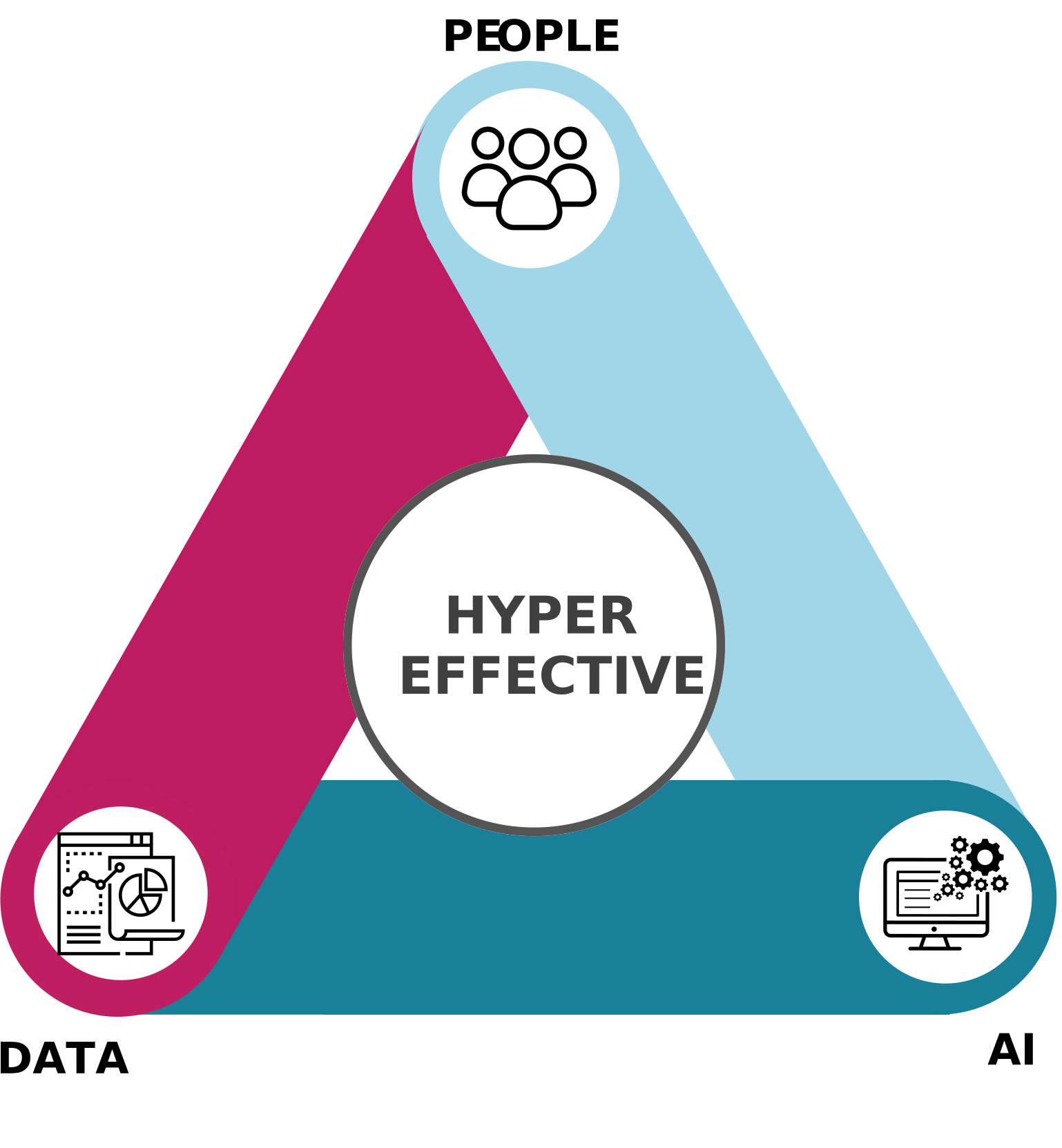
We start on the work floor
Every AI engagement starts with conversations. Not with your IT department, but with the people who do the work. Your planner, your quality manager, your team leader. How do they think? What information are they missing? Where do they lose time?
That knowledge is the raw material for everything we build. Because an AI agent that doesn't fit how your team works won't be used. And a solution that isn't used delivers nothing.
That's why we involve your stakeholders from day one. Not as spectators, but as co-owners. They decide what gets built. They test it. And they're the first to work with it.
From silo to foundation
Your data is everywhere. In SAP, Exact, Excel, emails, people's heads. Most organisations don't have a data problem. They have a connection problem. Data that doesn't come together is data that doesn't work.
We pull your data out of the silos and make it centrally available on BrainGrounds. That's the foundation. Only when your data is centralized can you put it to work.
No big-bang migration. We start with the data your first use case needs. Lean, fast, and immediately usable.
From data to action
With your data centrally on BrainGrounds we put it to work. The most concrete first step: BrainChat, a private AI chatbot on all your company data. Your team gets real-time answers to operational questions without searching through systems. From there we build further: a planning optimisation that runs on its own, a forecasting model that signals shortages before the customer calls, a report that prepares itself. The technology behind it: AI agents running on a private AI language model.
Your data stays sovereign. It is never shared with public AI models like ChatGPT or Microsoft Copilot. All processing happens within your own data environment on BrainGrounds.
Databricks, private language model, sovereign data. Technology that until recently was only available to organizations with their own data department. We make it accessible for mid-market companies. Fixed price, live in production.
Why do we do this? To free people from tasks a computer can do better. So they can do what makes us uniquely human.
How we work
Seven principles we never deviate from.
People first, technology follows
We start every engagement on the work floor. Not in the boardroom, not with IT. With the people who do the work. Their knowledge, their frustrations, and their way of working determine what we build. Technology that does not align with how people work does not work.
Not a project, but a partnership
We don't do standalone projects with hourly billing and a final report. We enter a partnership with guaranteed results. Your success is our success. Literally. We only do well when you see returns.
Stakeholders as co-owners
The people who will work with the solution help build it. Not after the fact in a demo, but from the very first conversation. That creates buy-in, quality, and solutions that actually get used.
Data that works, not data that reports
We don't build dashboards. We build systems that think ahead and act. The difference: a dashboard tells you what happened. Our solutions tell you what to do now.
Production, not pilots
We don't do endless pilots. Once the business case holds up, the solution goes into production. Your team works with it. For real. That means: faster results, faster learning, faster adjustments. The first version doesn't have to be perfect. It has to work.
Every step finances the next
We start with the use case that delivers the most value. That one finances the second. And the second finances the third. That's how you build a flywheel without the investment spiralling out of control.
The business case decides
If the business case doesn't add up, we don't start. No nice-to-have projects, no AI for AI's sake. Every euro you invest must demonstrably deliver more. We verify that upfront, not afterwards.
The process
From inspiration to production. No pilot in between.
Quickscan (30 min)
What: Which friction costs you the most time and money? How big is the impact? Which solution fits?
How: In 30 minutes we determine together which operational friction has the biggest impact. Concrete, with numbers.
Result: A concrete sprint proposal: which friction, how many weeks, fixed price. Not an advisory report.
Investment: Free, no obligations.
Production
What: With a go, we build the solution and put it into production. No pilot, no sandbox. Your team works with it.
How: In two-week sprints. Every sprint delivers working functionality. Your stakeholders are involved at every step. A private AI language model on your own data. Your data stays sovereign.
Result: A working solution that eliminates the friction and supports your team every day. Measurable results within weeks, not months.
Investment: Fixed sprint price, no hourly rates. Each sprint finances the next.
Scale
What: The first use case is running. Now we build further.
How: Every next use case goes faster because the platform is already in place and your team is already accustomed to the way of working. We prioritise based on expected ROI.
Result: A flywheel. Every step funds the next. Your organisation becomes hypereffective step by step.
The growth path
From first friction to hypereffectiveness
The entry point is always a friction. You choose based on what costs you the most. After six weeks that friction is eliminated and the next becomes visible.
Guarantee
What our approach delivers.
ROI over 5 years
Validated in the business case before we start.
Payback period
Standard part of the business case. Most clients come in well under that.
How we calculate
No promises. Math.
Before we start, we build the business case together. Three steps, concrete numbers.
What does the friction cost?
We quantify the problem in euros per year. Hours lost, errors, delays, missed revenue. Not vague, but concrete. Example: a planner who spends 15 hours per week on manual planning = EUR 40,000/year.
What does the solution save?
We calculate conservatively: 40-60% of the friction cost. Not the best case, but the realistic case. If the savings are less than 2x the investment, we don't start.
ROI over 5 years
Year 1: savings minus full investment (one-time + monthly). Year 2-5: savings minus monthly costs only. The platform is already in place, each next solution costs less.
Why each next solution gets cheaper
| Sprint investment | Includes | Why cheaper over time | |
|---|---|---|---|
| Sprint 1 | EUR 12,500 + EUR 2,500/mo | BrainGrounds + BrainChat + BrainDoc. Max 5 named users (EUR 50/mo per extra user). | The heaviest investment. You build the foundation: platform, connections, way of working. |
| Sprint 2 | +EUR 12,500 + EUR 3,000/mo | + BrainPlan (2 sprints). Planning that adjusts itself. Platform already runs. | No platform setup. Faster delivery. Total monthly after Sprint 2: EUR 3,000/mo. |
| Sprint 3+ | On request | Custom solutions + optimisations | Maximum leverage. Team knows the way of working, data flows are optimised. Each solution delivers faster than the previous one. |
The flywheel: Sprint 1 finances Sprint 2. Each step funds the next. The platform investment is made once. After that, each new friction you eliminate costs less and delivers faster. That's how 300%+ ROI over 5 years is built.
Trusted by organizations like








Compare
Three routes. One delivers.
Most organizations consider the same three options. Here's what each actually delivers.
| Internal team | Traditional consultancy | BrainStax | |
|---|---|---|---|
| What you get | Depends on capacity and knowledge | Roadmap and advice report | Working solution, live in production |
| Timeline | 6-18 months | 3-6 months (for the report) | First friction eliminated, fixed timeline |
| Investment | FTE costs + opportunity cost | EUR50K-200K (no production result) | EUR12,500 + EUR2,500/mo, fixed price |
| Risk | High: knowledge gap, no methodology | Medium: report done, then what? | Low: validated business case upfront |
| Data ownership | Yours, but often fragmented | Varies, often unclear | Yours. Private AI, sovereign data |
| After delivery | Dependent on key people | You still need to build it | Next friction, each step funds the next |
Convince your board
How to defend this decision internally.
The biggest risk isn't choosing wrong. It's not being able to explain why you chose.
For your CFO
"What does it cost and what does it deliver?"
EUR12,500 one-time + EUR2,500/month. Business case validated upfront: 300%+ ROI over 5 years, payback ≤11 months. Fixed price, no open-ended engagement. If the business case doesn't hold, we don't start.
For your IT manager
"Does this replace our systems?"
No. BrainGrounds is a supplementary data layer. Max 4 integrations, no system replacement. Private AI language model, sovereign data. ISO 27001 certified. IT keeps control.
For your board
"What if it doesn't work?"
80% of AI projects fail in the market. BrainStax has 80%+ success rate. The difference: we validate the business case before we start, we measure from week one, and we stop honestly if it doesn't work. You risk 30 minutes in the quickscan, not months of production.
Frequently asked questions
Questions about our method and guarantee
Which friction costs your organisation the most?
In a 30-minute diagnostic conversation we determine which friction costs you the most time and money. Business case holds? Six weeks later, live in production. Fixed price.
Or try the AI readiness scan first.